Start With The Site Rules And How The Car Park Works
Before any sign is made, walk the site and note how vehicles and people actually move. Look at entrance points, one-way circulation, loading bays, visitor bays, disabled bays and pedestrian crossings. In Table View, Milnerton and busy parts of Cape Town, poor flow quickly leads to blocked access and complaints.
Check whether the property is private, mixed-use or open to the public, because that changes the wording and the level of control you need. A small retail centre may need clearer directional signs than an office park, while a block of flats may need resident-only notices, tow-away warnings and bay numbering.
Match The Sign To The Rule You Want Enforced
Every sign should say exactly what you want people to do. If the instruction is vague, it will be ignored. Keep the wording short, direct and consistent across the site. Use the same terms for visitor bays, loading zones and no-parking areas so drivers do not get mixed messages.
- State the rule in plain language, for example Visitor Parking Only or No Parking At Any Time.
- Include times if the restriction changes, such as 07:00 to 17:00 or after hours only.
- Add who the rule applies to, like tenants, contractors, residents or visitors.
- Decide if you need arrows, bay numbers or a tow-away warning.
- Check whether the sign must support municipal or body corporate rules, not just site preference.
If you manage several properties across Blouberg, Parklands or Durbanville, keep the wording standardised. It makes replacement and maintenance far easier, especially when a sign is damaged in a collision or faded by coastal sunlight.
Pick ACM, Perspex Or ABS For Cape Town Parking Signs
Parking signs outdoors face sun, wind, dust and often salt air. Along the west coast, moisture and corrosion can shorten the life of poor fittings. Ask for materials and finishes that suit the site conditions, including the fixing method for poles, walls or fences. A good sign should stay readable in bright sun and at night when headlights hit it.
For light boxes, reflective parking signs or direction signs, check the viewing distance and angle. A sign near a boom gate needs different sizing than one placed at the back of a parking court. If the area is dimly lit or affected by load-shedding, reflective detail and clear contrast become more important, not less.
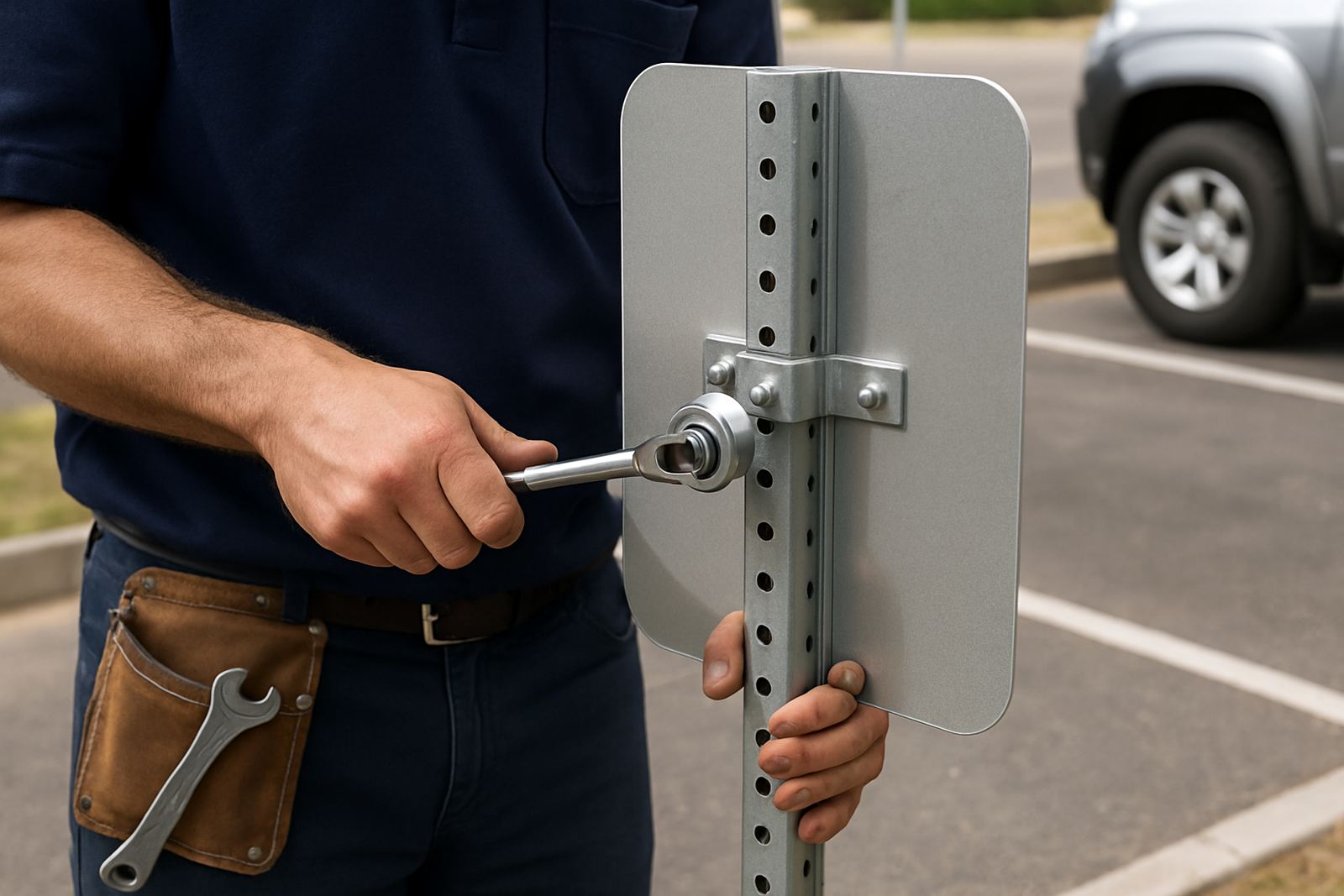
Also think about the surface it will be mounted on. Brick, concrete, palisade fencing and steel all need different fasteners. If a sign is too heavy for the mount, it may loosen over time and become a hazard.
Measure The Site Before You Place The Order
Accurate measurements prevent guesswork. Measure the available wall space, pole height, fence panels, driveway width and the distance from the driver’s line of sight. Check for trees, pipes, cameras, boom arms and existing electrical points that could interfere with installation. Small sites need careful planning because one sign in the wrong spot can block access or create a blind corner.
- Measure the width and height of each planned mounting area.
- Check the height of passing vehicles, including delivery vans and service trucks.
- Note any slope, uneven paving or low ceiling clearance in parking garages.
- Confirm where the sign will be seen from first, not just where it fits.
- Mark any underground services before drilling or core fixing starts.
If you are ordering several signs at once, create a simple site plan with bay numbers, arrows and mounting notes. That saves time during installation and helps the team place each sign correctly the first time.
Decide Which Signs You Need For Control And Safety
Most parking areas need more than one type of sign. You may need direction signs for traffic flow, bay labels for allocation, warning signs for speed control and safety signs for pedestrians. In larger sites, clear exit and entrance markers reduce confusion at peak times. A single gate entrance with no clear marking often causes double parking and reversals.
Common signs to consider include visitor parking, reserved parking, loading only, no stopping, one-way traffic, speed limit, disabled parking, tow-away warnings and pedestrian crossing notices. Safety signs around workshops, warehouses and vehicle service areas should also be checked, especially where forklifts or deliveries move through the same space.
For strata or commercial sites, it is worth reviewing the full set together. That way the wording, colour coding and arrow direction all line up properly, which keeps the site easy to use and easier to enforce.
Plan Installation, Maintenance And Replacement Early
Installation details matter as much as the sign itself. Ask where the sign will be fixed, who will provide access and whether work must happen after hours to avoid disrupting tenants or shoppers. In busy Cape Town locations, a neat after-hours install can be the difference between a smooth job and a blocked driveway.
Plan for maintenance too. Signs fade, get scratched, or are hit by vehicles. Keep a record of where each sign is installed so replacements can be ordered quickly with the same size and layout. It also helps when body corporate or municipal rules change and you need to update only part of the site.
Regular checks should include loose fixings, rust, faded print and damaged reflective film. A parking sign that cannot be read is usually treated as if it is not there.
Quick Pre-Order Checklist For Property Managers
Use this before you place the order so nothing gets missed. It is a simple way to catch problems before the signs go into production.
- Have you confirmed the exact rule, wording and times?
- Do you know the number of signs needed and where each one will go?
- Are the sizes suitable for the viewing distance and site layout?
- Have you checked wall, fence or pole fixing points?
- Will the signs hold up in sun, wind and coastal humidity?
- Do you need reflective detail, directional arrows or bay numbers?
- Is the site plan approved by the owner, body corporate or manager?
Once these points are settled, ordering becomes much simpler. It also gives a cleaner result on site, which is what most property managers want when they are dealing with tenants, visitors and compliance at the same time.