What UHMW does in a guide application
UHMW, or ultra-high molecular weight polyethylene, is valued for its low-friction surface and good impact resistance. In plain terms, it lets a component slide against another part with less drag, less noise and less metal-on-plastic wear than many general-purpose plastics.
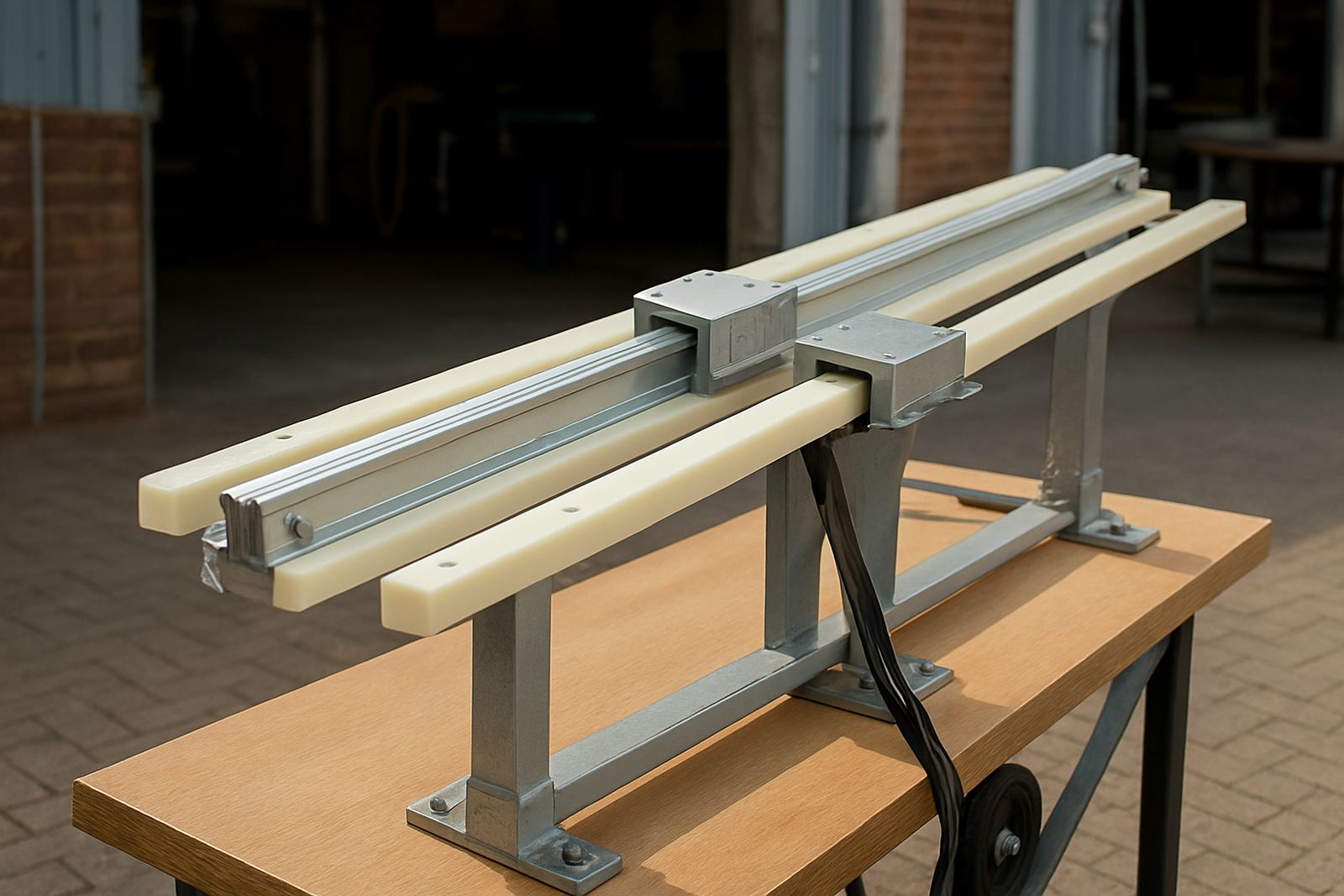
That is why it shows up in conveyor guides, chute liners, machine beds, packaging equipment and sliding wear strips. If a part must move repeatedly along a fixed path, and you want it to keep its shape without galling, UHMW is often a practical choice.
- Low friction for smooth movement
- Good wear resistance under repeated contact
- Handles impact better than brittle plastics
- Suitable for cut to size guide strips and liners
Where UHMW makes sense in Cape Town workshops
In Table View, Milnerton and Paarden Eiland, workshops often deal with dust, salt air and busy production schedules. UHMW copes well in many of these conditions because it does not rust and it keeps sliding well even when maintenance is not perfect. It is not a fix for bad alignment though, so the mounting and machining still need to be right.
We often see it used where timber wears too quickly, metal becomes noisy, or standard plastics start cracking at holes and corners. For businesses in Parklands, Durbanville and Montague Gardens, that can mean less downtime on conveyor lines, packaging equipment and custom handling gear.
- Conveyor side guides
- Wear strips and slide rails
- Machine liners and transfer points
- Custom cut pieces for production jigs
Design details that affect performance
The material choice is only part of the job. UHMW guides need the correct thickness, edge finish, hole spacing and support points if they are going to last. If a strip is too thin it can flex, if it is too thick it may not align properly, and if the fixing points are wrong the part can creep over time.
Temperature and load also matter. UHMW is stable for many day to day industrial tasks, but very high heat or sharp constant loading can change how it behaves. A good workshop will check the load path, the sliding surface, and whether the part needs chamfered edges or countersunk fixing points.
- Confirm the sliding surface is flat and aligned
- Allow for fixing holes and thermal movement
- Use proper radius corners where cracking could start
- Choose the right finish for the contact face
Machining UHMW for cut to size parts
UHMW machines well when the cutter is sharp and the feed is steady. It can be routed, drilled and engraved for many applications, although the operator must manage heat and chip build-up carefully. Clean edges matter because a rough edge can affect how a guide runs in service.
For local businesses, the advantage of a capable CNC workshop is that guide parts can be made to exact dimensions instead of forcing a standard sheet into an awkward fit. That helps when you are replacing a worn component on older equipment or adjusting a line that was modified over the years. Accurate machining also makes repeat orders easier, which saves time when the same part is needed again.
When UHMW is better than other plastics
UHMW is not the answer for every part. If a job needs high stiffness, very fine tolerance under heavy heat, or a decorative finish, another engineering plastic may be better. But for sliding wear parts, it often gives a better mix of toughness and low friction than materials that are harder but less forgiving.
It is particularly useful where the part will take repeated knocks or light abrasion. In that respect, it is a practical material for factories, packing areas and maintenance teams that need parts to keep going with limited fuss.
- Choose UHMW for sliding, guiding and wear applications
- Consider other plastics where rigidity or heat resistance is the main need
- Use proper machining rather than forcing a generic sheet into place
A local example from a Table View workshop
A packaging business in the Blouberg area may run guide strips that keep cartons centred as they move along a conveyor. If those strips wear unevenly the line can start snagging, and the operator ends up clearing jams more often. Replacing them with cut to size UHMW guides can reduce that friction and give a more consistent run.
That kind of work suits a combined signage and engineering workshop because the same team can handle measuring, cutting, routing and fitting. For businesses in Cape Town's west coast corridor, having one local point for both made parts and installation support is often easier than dealing with several suppliers, especially when production cannot stop for long.
If you need UHMW guides, it helps to bring a sample, drawing or worn part so the replacement can be matched properly. That makes it easier to check thickness, hole positions and the sliding face before manufacture begins.